

Is AI Killing the Next Michael Jackson Before The Genius Even Arrives?
The Machine Cannot Yearn.
The box office numbers around the new Michael Jackson biopic have dominated headlines and it looks like it might crack a billion. But the more unsettling story lies elsewhere. What we see in his storied life reveals about what we stand to lose.
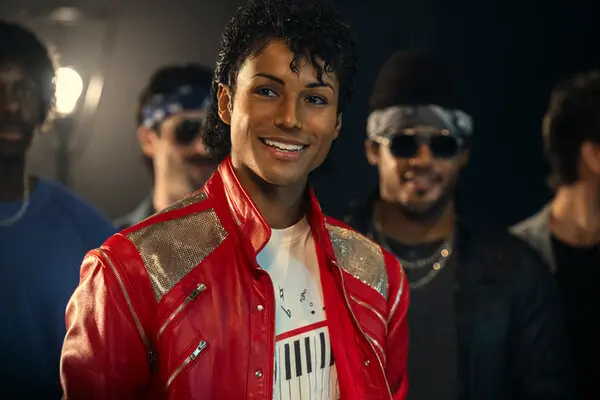
What struck me watching the film was not just the spectacle of Jackson’s superstardom, but his process. Ideas scrawled on mirrors. Lyrics jotted down before they vanished. Inspiration drawn from James Brown, Charlie Chaplin, the world around him and then alchemized into something unmistakably original. This was not productivity. This was transfiguration.
And it raises a question that our industry is not yet willing to answer honestly: what happens to creative transfiguration in an era increasingly run by machines?
At a recent Grammys on the Hill gathering in Washington D.C., much of the discussion focused on how to regulate artificial intelligence. We asked, “How do we protect artists legally, ethically, financially from this emerging tech?” But beneath the policy talk was a deeper philosophical fault line: whether AI-generated output deserves to be taken seriously as creativity at all.
To compare it to Jackson’s work is to misunderstand both.
His genius was not merely in the final product. It was in the lived experience behind it. It was the obsessive discipline, the strange contradictions, the relentless pursuit of something just beyond reach. When he created Thriller alongside collaborators like Quincy Jones and Rod Temperton, he wasn’t assembling data points. He was channeling something that cannot be quantified, only recognized.
Yes, AI can synthesize influences. It can approximate and emulate style. It can even, in certain narrow contexts, generate something that sounds like music. But it cannot yearn. It cannot struggle toward an uncertain horizon. And it cannot risk failure the way every serious artist must. Because failure, for a human being, is never merely technical. It is existential.
This distinction matters more urgently than our industry seems willing to admit.
READ ALSO: Man Pleads Guilty To Ripping Off $8 Million In AI Music Streaming Fraud
Artificial performers don’t demand ownership. They don’t renegotiate contracts. They don’t — as Jackson famously did — acquire publishing rights to the Beatles catalog. They definitely won’t publicly advocate for artists like Little Richard who were systematically undercompensated by an industry built on their labor. From a corporate standpoint, AI is frictionless. And that frictionlessness is precisely the appeal.
There is a growing suspicion — not unfounded — that the industry may no longer want superstars. Not the kind who challenge power structures, anyway. Why manage a global icon, with all the chaos that entails, when you can engineer a controllable output? Why invest in unpredictable human brilliance when algorithms can deliver consistent, scalable returns at a fraction of the cost?
AI-generated music is already flooding streaming platforms, diluting revenue streams and attention in ways that fall hardest on working musicians. These are the ones who haven’t already made it, the ones the system was already stacked against. This is not abstract. This is real. This is about who gets to survive as an artist.
We would do well to be clear-eyed about what AI actually is in this context. It is not a true creative force, but a reflection of one. Gen AI ingests the work of human artists including their risks, their failures, their hard-won discoveries and then produces statistical approximations. The output can be fluent. It can even be dope, lit or appealing. What it cannot be is authored, in the fullest sense of that word.
Consider Beyoncé, an artist whose precision and vision are so extraordinary they are sometimes described as almost mechanical. Yet what resonates is not the perfection itself, but the intention behind it. She curates the cultural references, the emotional architecture, the unmistakable vibration that a specific human being made this, for reasons that matter to her. Audiences feel it, even when they cannot name it.
Are we slowly training ourselves out of that feeling?
READ ALSO: RIAA CEO Warns Of AI’s Impact On Music & Copyright Law
A generation raised primarily on algorithmically optimized content may eventually lose the calibration to tell the difference between a performance and a product. By the way, this is not technophobia. I have always loved and embraced tech. But it is a reasonable concern about attention, values, and what we teach people to want. Art has always had a commercial dimension. The tension between commerce and expression is older than the music industry itself. Also, there has always been resistance to tech, especially as it relates to Hip-Hop. But there has generally been a floor — a baseline assumption that human experience drives the work. It also pushes the ingenuity. Strip that away, and what remains begins to feel less like art and more like furniture.
The lesson from Michael Jackson’s story is not that genius is fragile. It is that genius is costly. It comes at a price. It is costly to the person who has it, costly to nurture, and costly to protect. It demands institutions willing to invest in the long, uncertain arc of a human career rather than the reliable efficiency of a machine.
Artificial intelligence will reshape the landscape of creativity. It already has. Like Thanos, it is inevitable. The question is whether we build that new landscape in a way that still makes room for the kind of human alchemy that produced Off the Wall, Bad, and Thriller. Or whether we quietly decide that frictionless is good enough.
That choice belongs to us, not the algorithm. And definitely not the business.
If we make the wrong one, we may have bigger problems than the future of music.
